

In this blog, we look at how AI can be used at different stages of software modernization.
Taking over an old system – AI boosts initial analysis
Modernization projects often start with a status quo: what the system actually does, what it is connected to and how well documented it is. In legacy systems, information may be scattered or only behind certain key people.
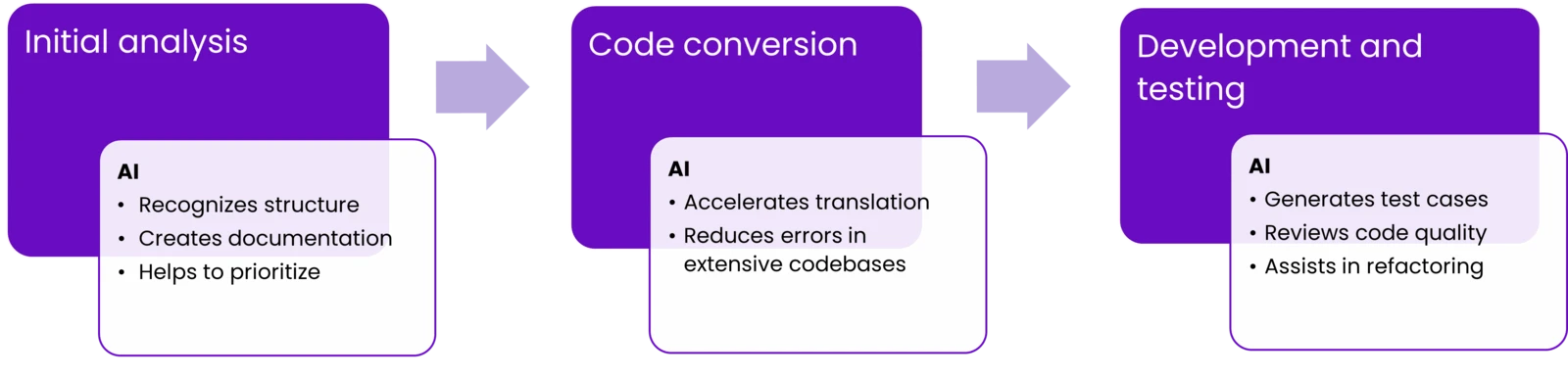
AI can already be used at this stage, for example in the following ways:
- Analysis of code structure and repetitions
- Automation of documentation creation
- Structuring user interfaces and operational logic
This helps to quickly build up an overview of the system and to prioritise development work correctly.
Code conversion – AI speeds up the rewriting of repetitive structures
One of the most effective ways to use AI is to convert massive code bases containing tens of thousands of lines of code. The AI-assisted approach enables fast and consistent translation.
AI is particularly well suited:
- To rewrite a repetitive structure without errors
- For preliminary sketching of long components
- Automating monotonous and time-consuming work
In this way, AI frees up expert time for more challenging tasks, such as designing the architecture and refactoring.
Streamlining the development process – AI supports documentation, testing and quality assurance
The role of AI is not limited to just writing code. It can support the entire software lifecycle:
- Documentation: AI can automatically generate and maintain technical documentation as part of the development process, allowing developers to focus more on the content and functionality of the documentation.
- Quality assurance: AI can be used to identify potential vulnerabilities in the code and suggest improvements at an early stage.
- Testing: AI can be used to generate test cases and help build integration and unit tests. The developer can then focus more on designing test coverage. Comprehensive integration tests also provide a good basis for refactoring the system in a safe and iterative way.
Summary: AI in software modernization
Properly managed, AI offers a number of accelerating and even enabling benefits for system modernization.
- Faster progress: automatic code conversion and analysis significantly reduces project time.
- Fewer mistakes: AI processes repetitive structures quickly and consistently, while preventing human error.
- More complete and up-to-date documentation: AI can maintain and complete documentation that may be partially or completely missed in a hurry. AI also speeds up the process of updating documentation, as detailed review can easily take up a lot of developer's time.
- More flexible development: AI speeds up testing and quality assurance, allowing faster iteration, which in plain terms means that, again, more can be achieved in less time.
- Cost-efficiency: less manual work and a better focus on expert work.
Among other projects, we have modernized the calculation systems of a financial industry client. The modernization has been done in an AI-enhanced way, so that the technical modernization from a programming language to a more modern programming language and the architecture upgrade have been implemented using AI tools. Fluentia's AI toolkit significantly helped to manage the risk of modernization when upgrading business-critical computing applications. Compared to a more traditional modernization project, the project was able to avoid manual coding errors and expand the amount of automation testing for quality assurance.
Contact us to see how AI-enhanced software modernization could strengthen your business!
Read more about: