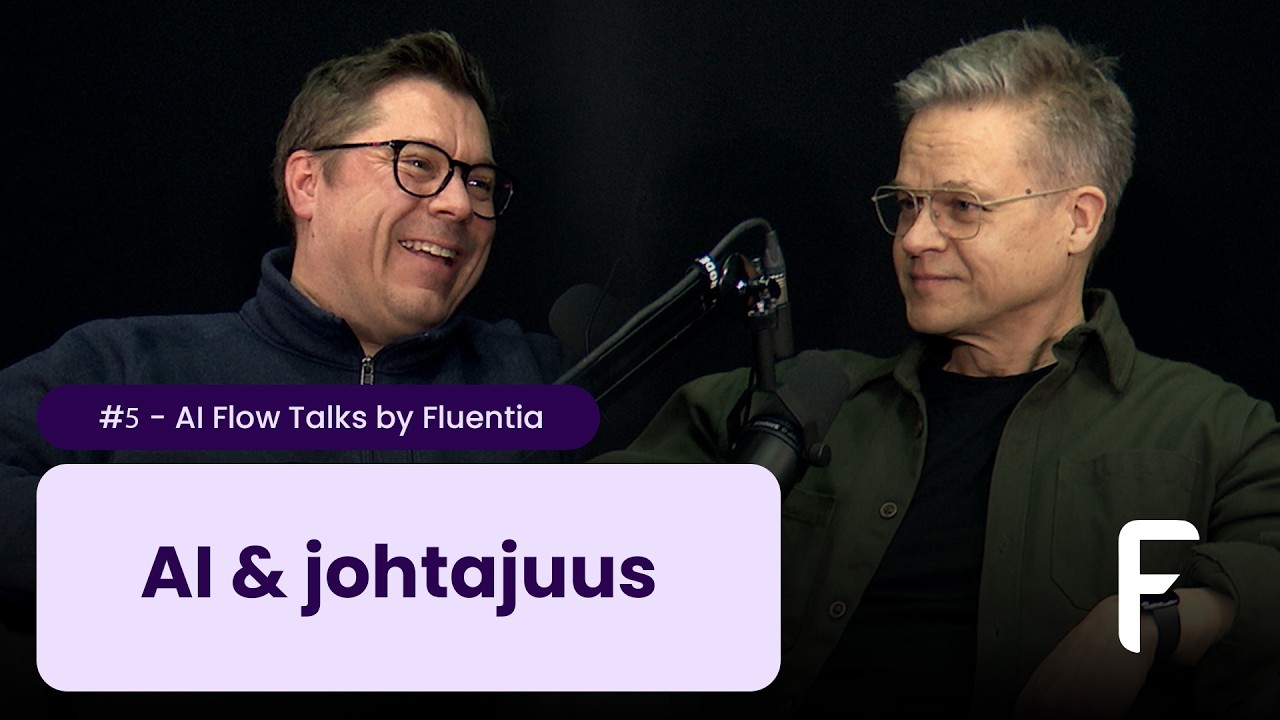
Our AI Flow Talks podcast series shares real-life stories from the world of AI to help organizations navigate their AI transformation more easily. In this episode, we discuss what happens to thinking, learning, and creativity as AI becomes an ever more integral part of work and everyday life.
The guest joining Fluentia CEO Sami Vaskuri is Johanna Kaakinen, Professor of Psychology at the University of Turku. Kaakinen studies human information processing, attention, memory, and learning, and leads the European EYE-TEACH project, which explores how AI and eye-tracking data can support learning.
Human thinking has its limits
The conversation starts from the basics of human information processing. Attention and working memory set limits on how much we can handle at once. In practice, we can properly focus on only one thing at a time, and working memory capacity is limited as well.
That is why multitasking is largely rapid switching of attention from one task to another. The more often attention has to be shifted, the more the work loads us. Interruptions also make it harder to return to what we were just doing.
AI can ease this load by taking on some of the tasks. At the same time, there is a risk of so-called cognitive offloading: we gradually hand over to AI thinking that we should still practice ourselves.
AI can support learning, but it cannot replace thinking
In learning, AI offers many opportunities. It can, for example, give personal feedback when a teacher does not have time, act as a tutor that guides studying, or help a student test their own understanding through conversation and questions.
According to Kaakinen, the most interesting opportunities arise when AI does not merely imitate work a human would do, but makes something entirely new possible.
The EYE-TEACH research project is an example of this. Its aim is to understand individual learning processes more clearly and to support learning with the latest eye-tracking research and AI-assisted technology. The project studies and uses eye-tracking data on what happens in a student’s mind while reading. The purpose is not to replace the teacher, but to give them new tools for supporting students.
The other side of using AI: laziness and false confidence
The episode also looks at research on how using language models affects people’s own thinking. One phenomenon that comes up is cognitive laziness: when a tool does the thinking for us, our own willingness and habit of struggling with a problem can fade.
Another interesting question concerns metacognition: our ability to assess our own competence. Based on a study discussed in the episode, using ChatGPT improved people’s performance on tasks that require logical reasoning, while users also overestimated their own skill. AI can therefore help produce the right answer without the user’s own understanding growing at the same rate.
That is why critical thinking and source criticism matter even more in the age of AI. An AI-generated answer can sound convincing even when it quietly steers thinking in the wrong direction or reinforces the user’s prior assumptions.
Efficiency also needs room for the mind to wander
AI can make work more efficient, but constant efficiency is not necessarily the ideal state for thinking.
The episode highlights the value of mind-wandering. Although losing focus is often seen as a negative, research has also linked free wandering of thought to creativity, connecting ideas, and recovery. Sustaining attention for long periods, by contrast, is taxing.
This can be especially visible in AI-native software development, where a developer may steer several AI agents at once and keep shifting attention from task to task. Productivity may rise, but so can cognitive load. Alongside efficiency, we still need moments when thinking is allowed to wander.
Does AI increase creativity, or make thinking more uniform?
Language models can help an individual generate new ideas and find solutions they might not have come up with on their own. At the same time, studies have found an interesting flip side: when many people use AI to support ideation, their outputs can start to look more alike.
From an individual’s perspective, AI can therefore increase creativity, while at a collective level it may reduce the most unusual and surprising ideas. The homogenization of thinking emerges toward the end of the discussion as one of AI’s significant long-term risks.
Ethical questions in the use of AI
The effects of AI on thinking and learning cannot be separated from the ethics of how it is used. The episode stresses responsibility for how AI is applied and what consequences that use can have for people.
One key question concerns privacy and the use of data. Eye-tracking data used to support learning can offer valuable insight into the learning process, but it is also important to be clear about what information is collected, how it is processed, and who can access it. The use of AI must be transparent, and people need to understand what their data is used for. The European Union’s AI Act also addresses these questions.
Another ethical question concerns responsibility and decision-making. AI can produce convincing but incorrect answers, and responsibility for whether information is accurate cannot be handed over to the system. People still have to evaluate what AI produces, recognize its limits, and own the outcome.
The episode also raises equality. If AI starts to guide learning or assess people’s skills, it is important to make sure it does not reinforce existing gaps or treat people from different backgrounds unfairly. AI should support people, not narrow their opportunities or replace human judgment in situations where it is needed.
The benefit comes from how we use AI
The central theme of the episode is that AI is not simply good or bad for thinking. The effect depends on which tool is used, what it is used for, and how the user relates to the answers it produces.
AI works well for automating routine work and sparring with your own thinking. At the same time, people need to keep the ability to evaluate information critically, recognize the limits of their own expertise, and think without a ready-made answer from AI.
This also matters for education in the future. AI literacy includes not only using AI tools, but also understanding their limits and being able to evaluate the content they produce. That still rests on traditional fundamentals, such as literacy and source criticism.